The Standing Committee (SC) of the Convention has granted the Ghana Standards Authority (GSA) the status of Observer.
GSA is the Convention’s fourth authority to become an Observer but the first authority from Africa to be granted a status with the Convention.
Non-Members of the Conventiona, which want to participate in SC meetings as well as in the Convention’s Round Robin (interlaboratory proficiency testing scheme on precious metals), can apply for the status of either Observer or Technical Programme Participant (TPP).
There are now 4 Observers:
- Ghana Standards Authority
- Assay Office of Moldova
- Bureau of Metrology, Montenegro
- KRISOS (Asociación Española de Laboratorios Acreditados en el Área de Metales Preciosos), which comprises six laboratories in Spain in the field of precious metal control: Instituto Tecnológico Metalmecánico, Mueble, Madera, Embalaje y Afines (AIDIMME), Centro de Laboratorios de Madrid (CLYSIM), Dpto. Verificación y Análisis (SAVECO), Instituto Tecnológico de la Bisutería (ITEB), Collegi Oficial de Joiers, d’Orfebres, de Rellotgers i de Gemmòlegs de Catalunya (JORGC).
There are currently 9 TPPs:
- Institute of Metrology of Bosnia and Herzegovina
- National Jewellery Quality Supervision and Inspection Center of China (with branch in Shenzhen)
- Assay Office of North Macedonia
- Assay Office of Mauritius
- Assay Office of Mongolia (based in Ulaanbaatar with branches in Bayankhongor and Darkhan-uul)
- Singapore Test Services Pte Ltd, Assay Office of Singapore
- ECOMEP Laboratorio de Contraste de Córdoba of Spain
- LGAI Technological Center S.A. (APPLUS) of Spain
- The Gem and Jewelry Institute of Thailand (GIT)
The Convention on the Control and Marking of Articles of Precious Metals is an international treaty between States on the cross-border trade in precious metal articles. It was signed in Vienna in November 1972 and entered into force in 1975.
It is also known as the “Hallmarking Convention”, the “Vienna Convention” or the “Precious Metals Convention”.
The Convention aims at facilitating the cross-border trade of precious metal articles between Contracting States (i.e. States which are party to the Convention) while maintaining consumer protection. The scope of the Convention is strictly limited to the control of the precious metal content, not to health, security or other aspects of precious metals articles.
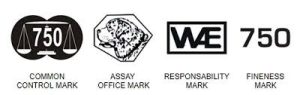
The Convention establishes a common set of technical requirements for the independent third-party verification of precious metals articles. Each Contracting State recognises that articles, which have been marked with the Convention “Common Control Mark” (CCM) and which are of a legal fineness, can enter its territory without additional control or marking.
The CCM is the first international hallmark and is accepted in all the Convention’s Contracting States. It is also recognised as a “quality” symbol in other countries. As a result, the CCM makes it easier for quality precious metals articles, for which there is a high demand, to travel and cross borders. The number of articles, marked with the CCM every year, reaches approximately 5 million.
The Convention, which is based on the principle of independent, third-party control, has greatly contributed to the harmonisation of standards related to the control and marking of precious metals articles and still continues to be the leading organisation in the field.